




|
Guide to design the solar charge
controller Solar charge
controller has the input
voltage from the PV module
and the output voltage
suitable to charging voltage
of the
battery. Therefore we select
the solar charge controller
to match the voltage of PV
array and batteries. Then
identify what solar charge
controller is right for your
application. Also make sure
that solar charge controller
has enough capacity to
handle the current from PV
array.
According to practice, the
sizing of solar charge
controller is to take the
current equal the short
circuit current (Isc) of the
PV array multiply by 1.3
Solar charge controller
rating = Total short circuit
current of PV array x 1.3
For MPPT Solar charge
controller we have another
method to choose the
controller.
What is MPPT?
MPPT or Maximum Power Point
Tracking is algorithm that
included in charge
controllers used for
extracting maximum available
power from PV module under
certain conditions. The
voltage at which PV module
can produce maximum power is
called ‘maximum power point’
(or peak power voltage).
Maximum power varies with
solar radiation, ambient
temperature and solar cell
temperature.
Typical PV module produces
power with maximum power
voltage of around 17 V when
measured at a cell
temperature of 25°C, it can
drop to around 15 V on a
very hot day and it can also
rise to 18 V on a very cold
day.

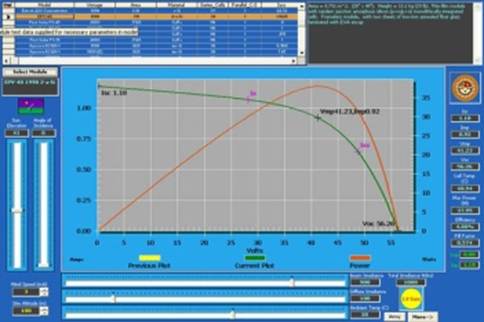
Figure 1 The I-V curves show
maximum power from PV
modules when exposed to
irradiance 1000 W/m2
Source: The parameters are
measured by the IVTracer
program by Sandia National
Laboratories

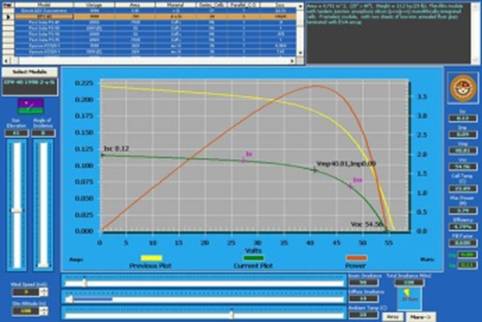
Figure 2 The I-V curves show
maximum power from PV
modules when exposed to
irradiance 100 W/m2
Source: The parameters are
measured by the IVTracer
program by Sandia National
Laboratories.
As the graphs in figure 1
and 2, we see that at the
different solar radiations,
PV modules deliver the
variations in parameters as
follows:
(1) Maximum power; Pm
(2) Maximum power voltage;
Vpm
(3) Open circuit voltage;
Voc
(4) Maximum power current;
Ipm
(5) Short circuit current;
Isc
How MPPT works?
The major principle of MPPT
is to extract the maximum
available power from PV
module by making them
operate at the most
efficient voltage (maximum
power point). That is to
say:
MPPT checks output of PV
module, compares it to
battery voltage then fixes
what is the best power that
PV module can produce to
charge the battery and
converts it to the best
voltage to get maximum
current into battery. It can
also supply power to a DC
load, which is connected
directly to the battery.
MPPT is most effective under
these conditions:
• Cold weather, cloudy or
hazy days: Normally, PV
module works better at cold
temperatures and MPPT is
utilized to extract maximum
power available from them.
• When battery is deeply
discharged: MPPT can extract
more current and charge the
battery if the state of
charge in the battery is
lowers.
MPPT solar charge controller
A MPPT solar charge
controller is the charge
controller embedded with
MPPT algorithm to maximize
the amount of current going
into the battery from PV
module.
MPPT is DC to DC converter
which operates by taking DC
input from PV module,
changing it to AC and
converting it back to a
different DC voltage and
current to exactly match the
PV module to the battery.
Examples of DC to DC
converter are
•
Boost converter is power
converter which DC input
voltage is less than DC
output voltage. That means
PV input voltage is less
than the battery voltage in
system.
•
Buck converter is power
converter which DC input
voltage is greater than DC
output voltage. That means
PV input voltage is greater
than the battery voltage in
system.
MPPT algorithm can be
applied to both of them
depending on system design.
Normally, for battery system
voltage is equal or less
than 48 V, buck converter is
useful. On the other hand,
if battery system voltage is
greater than 48 V, boost
converter should be chosen.
MPPT solar charge
controllers are useful for
off-grid solar power systems
such as stand-alone solar
power system, solar home
system and solar water pump
system, etc.
Main features of MPPT solar
charge controller
• In any
applications which PV module
is energy source, MPPT solar
charge controller is used to
correct for detecting the
variations in the
current-voltage
characteristics of solar
cell and shown by I-V curve.
• MPPT solar charge
controller is necessary for
any solar power systems need
to extract maximum power
from PV module; it forces PV
module to operate at voltage
close to maximum power point
to draw maximum available
power.
• MPPT solar charge
controller allows users to
use PV module with a higher
voltage output than
operating voltage of battery
system. For example, if PV
module has to be placed far
away from charge controller
and battery, its wire size
must be very large to reduce
voltage drop. With a MPPT
solar charge controller,
users can wire PV module for
24 or 48 V (depending on
charge controller and PV
modules) and bring power
into 12 or 24 V battery
system. This means it
reduces the wire size needed
while retaining full output
of PV module.
• MPPT solar charge
controller reduces
complexity of system while
output of system is high
efficiency. Additionally, it
can be applied to use with
more energy sources. Since
PV output power is used to
control DC-DC converter
directly.
• MPPT solar charge
controller can be applied to
other renewable energy
sources such as small water
turbines, wind-power
turbines, etc.
How to choose MPPT solar
charge controller for PV
module and battery
Steps to consider for
choosing MPPT solar charge
controller
• SPT-XXYY (XX is nominal
battery voltage, YY is
maximum charge current)
• Find out what is nominal
battery voltage that charge
controller will charge and
select XX
• Find out what is Wp of PV
module and
• Select the suitable charge
current (CC) = (Wp) / XX
• Find out YY by multiply CC
by safety factor (NEC
requirement) = (CC) x 1.2
• Select SOLARCON SPT-series
model that covers YY
• Check that Vpm(system) is
in range that SPT-XXYY can
handle (MPPT voltage range)
• If PV modules are in
series, need to check that
Vpm(system) = Vpm(module) x
Module in series
• If PV modules are in
parallel, need to check that
Vpm(system) = Vpm(module)
• Check that Voc(system) is
not more than SPT-XXYY range
(Maximum open circuit
voltage)
• If PV modules are in
series, need to check that
Voc(system) = Voc(module) x
Module in series
• If PV modules are in
parallel, need to check that
Voc(system) = Voc(module)
|